Palms don't age like oaks — they just quit. A queen palm that took a hard freeze, a royal with ganoderma rotting its base, a sabal struck by lightning: once the crown goes, there's no coming back, and a forty-foot dead palm is a forty-foot hazard hanging over your pool cage, your roof, or the sidewalk. Dead palms also drop heavy fronds and become nesting sites for rats and roaches.
We remove palms safely from the top down — fronds and boots stripped, trunk sectioned and lowered, never just pushed over onto whatever's nearby. Tall palms near pool cages and power drops are routine work for us. The fibrous trunk cuts differently than hardwood, and our crews know the difference.
If your palm's crown is shrinking, the trunk feels soft, or it's developed a lean it didn't have, call. A dead palm is one storm away from falling, and palms always fall exactly where you don't want them.
Signs a palm needs removal
- The crown shrinking or new spears failing to emerge
- Trunk soft or spongy at the base — possible ganoderma butt rot
- Shelf-like conks (mushrooms) growing on the lower trunk
- A new lean, especially after wind or heavy rain
- A skirt of dead fronds that won't drop — fire and pest hazard
- A queen palm browned out by a hard freeze with no recovery
How we remove a palm
1 Assess lean and hazards
We check the lean, the trunk's soundness, and everything within fall range — pool cages, roofs, fences, lines. Palms are top-heavy and unpredictable when dead, so the plan accounts for the worst case.
2 Strip from the top down
Climbers remove fronds, boots, and seed pods first, working down the trunk. Dead material comes off in controlled pieces — heavy palm fronds are no joke when they drop.
3 Section the trunk
The trunk is cut in sections and lowered with rigging where space is tight, or directionally felled where there's room. Fibrous palm wood behaves differently than oak — our crews cut it daily.
4 Grind and clean up
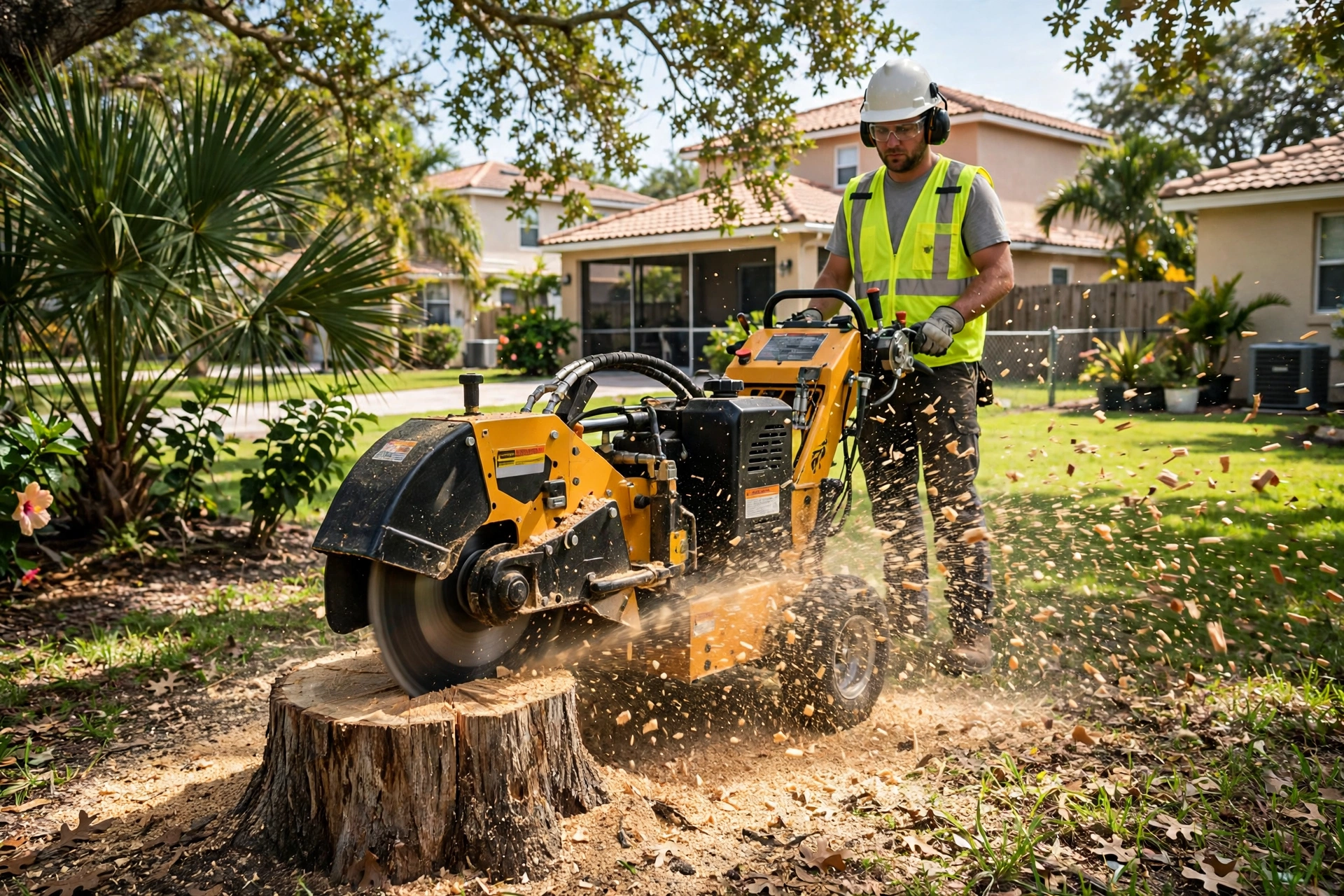
The stump is ground below grade, all debris is hauled, and the site is raked clean. If you're replanting, we'll talk through what works in that spot — including what killed the last one.
Palms on the central Pinellas coast
Dunedin is palm country — sabal palms (the state tree) volunteering everywhere, queen palms lining driveways, royals marking the nicer corridors. But the Gulf coast is hard on them: salt wind desiccates fronds, saturated soil topples shallow-rooted queens in tropical systems, and the occasional hard freeze browns out queens that never recover. Ganoderma butt rot — the shelf fungus that rots the trunk base — is common here and always fatal; there's no cure, only removal before the palm fails. Around downtown and the waterfront, dead palms are also a look problem — visitors notice. We remove and replace palms across the city, and we'll tell you honestly whether yours is sick, dead, or just ugly.
Need palm tree removal in Dunedin?
No forms, no waiting — one call connects you with a local technician.
(555) 123-4567 📞 Call Now